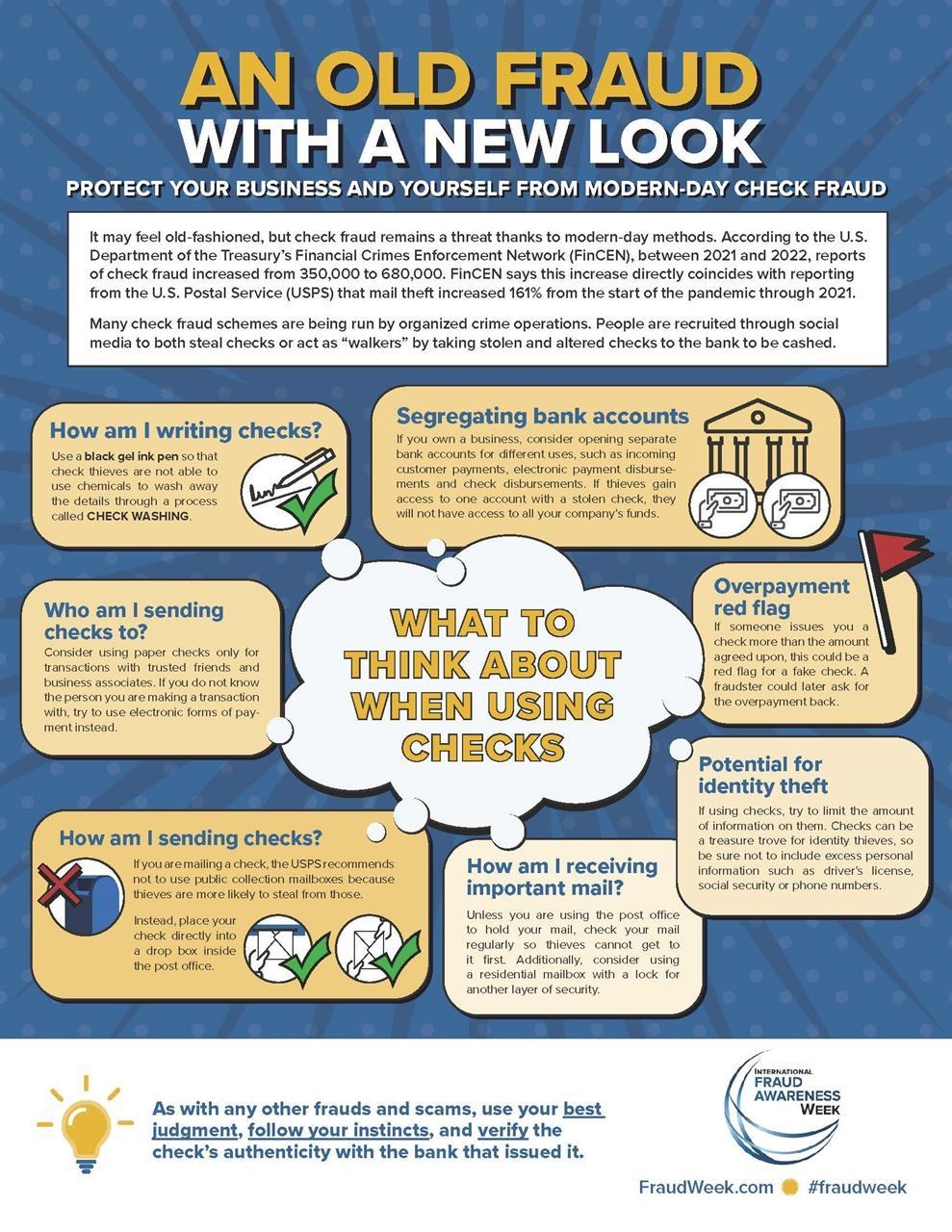
An Old Fraud With a New Look: Protecting Yourself and Your Business From Modern-Day Check Fraud

Even in a world of digital wallets, instant transfers, and mobile banking, one old-school financial tool continues to attract modern criminals: the paper check. As surprising as it may sound, check fraud is not only alive and well—it’s increasing at an alarming rate.

According to the U.S. Department of the Treasury’s Financial Crimes Enforcement Network (FinCEN), reports of check fraud nearly doubled between 2021 and 2022, rising from 350,000 to 680,000 cases. Much of this surge is tied directly to organized theft of mail from the U.S. Postal Service, which saw mail-theft complaints increase 161% since the start of the pandemic. In the fraud-prevention world, that is a staggering trend.

Continue reading “An Old Fraud With a New Look: Protecting Yourself and Your Business From Modern-Day Check Fraud”

Warning: Fraudulent DMV Text Scams on the Rise – How to Spot and Stop Them

In recent months, residents across many states have been targeted by a surge in scam text messages impersonating various state Department of Motor Vehicles (DMV). These fake texts claim that your license is suspended, that you owe fees, or that your DMV record needs urgent verification. The real goal? To trick you into clicking malicious links and stealing your personal or financial information.

As Certified Fraud Examiners, we’ve seen this playbook before—only the branding changes. Whether it’s posing as the IRS, a bank, or the DMV, scammers rely on urgency, fear, and official-looking messages to make you act without thinking.

Here’s what you need to know to protect yourself and how these scams operate behind the scenes.

Continue reading “Warning: Fraudulent DMV Text Scams on the Rise – How to Spot and Stop Them”

ebay Fraud Schemes: A Certified Fraud Examiner’s Guide for New Sellers

As Certified Fraud Examiners (CFEs), we’re trained to spot the red flags of fraud before losses occur. In the world of e-commerce, platforms like eBay offer lucrative opportunities—but also a breeding ground for deceptive behavior. While most transactions are legitimate, new sellers are especially vulnerable to scams that can chip away at profits and trust.

This article breaks down five common fraud schemes targeting new eBay resellers and offers preventative strategies rooted in fraud examination principles: verification, documentation, deterrence, and reporting.

Continue reading “ebay Fraud Schemes: A Certified Fraud Examiner’s Guide for New Sellers”

Government Contracting Fraud: What It Is, How It Works, and Why Taxpayers Should Care

When government money is on the table—especially big money—fraud isn’t far behind. Every year, billions of taxpayer dollars are spent on contracts for goods and services. These range from building roads to supplying military gear to maintaining IT systems and where there’s money, there’s the potential for fraud, waste, and/or abuse.

Continue reading “Government Contracting Fraud: What It Is, How It Works, and Why Taxpayers Should Care”

John R. Janicek Named NACVA 2023–2024 CVA Coach of the Year

The National Association of Certified Valuators and Analysts® (NACVA®) has named John R. Janicek, CPA, CVA, ABV, CFF, FCPA, CRFAC, MAFF, the recipient of the 2023–2024 CVA Coach of the Year Award, recognizing his exceptional contributions and unwavering support to candidates pursuing the prestigious Certified Valuation Analyst® (CVA®) credential.

Continue reading “John R. Janicek Named NACVA 2023–2024 CVA Coach of the Year”

Fraud Examiners in the Classroom: Lessons from the Front Lines of Academic Integrity

After working in military service, public accounting, corporate finance, and fraud examination, I’ve grown used to chaos—the kind of chaos that requires discipline, documentation, and a deep understanding of how deception works in the real world. But I’ve recently discovered that higher education, particularly in today’s age of online learning and artificial intelligence, is facing its own integrity crisis. And yes, Certified Fraud Examiners (CFEs) have something important to contribute here.

Continue reading “Fraud Examiners in the Classroom: Lessons from the Front Lines of Academic Integrity”

What Fraudsters Can Do With Your Bank Account Number

A compromised bank account number may seem harmless at first glance—but in the hands of cybercriminals, it can lead to a series of damaging financial crimes. From unauthorized withdrawals and online purchases to identity theft and tax fraud, the risks are real—and growing.

Here’s a breakdown of what fraudsters can do with your banking details, and how you can protect yourself.

Continue reading “What Fraudsters Can Do With Your Bank Account Number”

Strengthening Accounting Systems for Fraud Prevention: A Forensic Accounting Perspective

In today’s complex business environment, an effective accounting system is more than just a tool for recording transactions—it’s a frontline defense against fraud. Forensic accountants often uncover financial misconduct due to weak or outdated accounting systems that fail to detect irregularities. Therefore, developing and continuously improving an organization’s accounting system is not only about efficiency but also about fraud prevention.

Continue reading “Strengthening Accounting Systems for Fraud Prevention: A Forensic Accounting Perspective”

AI-Powered Fraud in 2025: Emerging Threats and What You Need to Know

As we move further into 2025, one thing is becoming increasingly clear: fraud is evolving, and artificial intelligence (AI) is at the heart of this transformation. Fraudsters are harnessing the power of AI tools to launch more sophisticated, convincing, and widespread scams. From deepfake-enhanced Business Email Compromise (BEC) attacks to synthetic identity fraud and healthcare system breaches, AI is making it easier for criminals to deceive victims and cause significant financial damage. Let’s dive into some of the major fraud trends that are expected to dominate in 2025.

Continue reading “AI-Powered Fraud in 2025: Emerging Threats and What You Need to Know”

The Pitfalls of Offshore Accounting: A Forensic Accounting Perspective

Offshore accounting has long been a subject of debate in financial and legal circles. While there are legitimate reasons for businesses and individuals to hold offshore accounts—such as asset protection, international business expansion, and tax planning—the misuse of offshore structures has made them a favorite tool for tax evasion, fraudulent financial reporting, and money laundering.

From a forensic accounting perspective, offshore accounts present numerous challenges in detecting and preventing financial crime. This post will explore the pitfalls of offshore accounting, its use for tax evasion and creditor fraud, and why it has become a preferred tool for criminals over the years.

Continue reading “The Pitfalls of Offshore Accounting: A Forensic Accounting Perspective”